How To Give Gifts That Actually Land


Table of contents
The Path to Becoming an Athena Assistant
Only the top 1% of applicants make it to the Athena Bootcamp – an acceptance rate more exclusive than Harvard University.
Every year, the same thing happens. The calendar tilts toward the holidays, your inbox fills with “Last-Chance!” sales, and suddenly gift-giving feels less like a gesture of love, connection and gratitude, and more like a fast-approaching to-do list you never meant to write.
What if we treated gifting the way some teams treat their best work, with Kaizen in mind? Kaizen is a simple idea from Japan that focuses on small, continuous improvements instead of big, dramatic overhauls.
Applied to gifts, Kaizen means you do not wait for December to figure everyone out. You notice one small detail about how someone lives, you write down one idea, you upgrade one habit in how you choose and present things. Season after season, those tiny improvements add up until gifting feels less like a scramble and more like a quiet craft you have been practicing all year.
This is a practical guide to giving gifts that actually land. Gifts that are used, remembered, and talked about long after the season ends.
What memorable gifts have in common
If you think about the best gifts you have ever received, they probably were not the biggest or the fanciest. They usually share three things.
- They fit your real life.
The scarf that makes your brutal morning commute warmer. The cookbook that matches the way you actually cook. The lamp that fixes the dark corner of your workspace. - They carried a story.
Olive oil from a tiny farm a friend visited. A notebook from a shop in Kyoto with a line inside about the trip. A mug that comes with, “I saw this and it looked like your Monday meetings.” - They slipped into a ritual.
The candle you light during your evening reading. The throw you pull out every Sunday afternoon while watching TV on the couch. The pen that sees you through a big project.
Research on spending money on others finds it can increase our own happiness, especially when it strengthens connection.
The habits of people who are “weirdly good” at gifts
You probably know at least one person who always nails it. Here is what they are doing that most of us are not.
“The older I get, the less I care what the gift is and the more I care that someone thought about me at all.”
The people who are quietly great at gifting seem to understand this instinctively. Here is what they are doing that most of us are not.
1. They notice more than they shop
Months before they buy anything, they are collecting tiny data points:
- What people reach for every day
- What they complain about (“My office is freezing”, “I never have decent olive oil”)
- What they dream about doing
- What they are using down to the last thread
They jot these in a notes app, or just keep a mental file. By the time the gifting season arrives, they are not starting from zero. They are simply matching ideas to people.
Why it works: Observation is the real luxury. A $25 gift anchored to a specific detail beats a $250 guess almost every time.
2. They give to the life someone actually lives
Aspirational gifts are tempting, but they tend to overlook the reality of what the receiver will actually use. The fancy yoga mat for the person who has mentioned yoga once. The complicated kitchen gadget for the takeout loyalist.
Thoughtful givers aim lower, right into the middle of ordinary life: cozy socks for the friend who is always cold on Zoom calls, a nicer version of the notebook your colleague burns through every quarter, a carry-on pouch for the parent who is constantly hunting for snacks and wipes.
A good gift says: “I understand your real life.”
3. They think in rituals, not objects
Instead of starting with, “What should I buy?”, they start with, “What small moment could I make better?” Some could include:
- Morning coffee
- Late-night reading
- Sunday cooking
- Work-from-home afternoons
- Solo travel days
- Work-outs and wellness practices
Then they look for something that plugs directly into that moment. Great tea. A reading light. A small speaker for the kitchen. A better desk throw. A travel pouch.
Why it works: Rituals happen over and over. Every time they do, the gift shows up again.
4. They choose things that move
The strongest gifts literally do something:
- Books circulate. A story you loved does not stay on your shelf, it moves through other people’s homes and evenings, picked up on commutes and beside beds. Each time someone else reads it, the gift quietly keeps working, long after you stopped thinking about it.
- Food and drink gather people. A box of good chocolates, a bottle of something special, a tin of cookies on a kitchen counter, all invite others in. The gift shows up in small moments around a table, in conversations and laughter, not just in the first unwrapping.
- Tools quietly earn their keep. A sharp knife, a reliable charger, a well made tote, these do not draw attention to themselves. They simply work, again and again, and each time they save a little effort or solve a small annoyance, the giver comes to mind.
- Experiences linger in memory. A gift card to a cafe they already love, tickets to a local event, a class you know they have been wanting to try, these create stories instead of clutter. When they go back a second or third time, the experience has become a small ritual, and your gift is part of it.
These items move through a person’s life rather than sitting on a shelf requiring dusting. With every use, the giver gets remembered.
5. They add a trace of themselves
The object is about the recipient. The gesture is about the relationship.
So they add something small:
- A handwritten note explaining why this reminded them of you
- A story about where they found it (“tiny shop in Seoul, owner insisted I try this one”)
- A memory or photo tucked inside a frame or book
- A recipe taped into the front of a cookbook
This does not have to be poetic. One honest sentence is enough: “You mentioned your evenings felt chaotic. I hoped this would make one of them quieter.”
6. They care (just enough) about presentation
No one needs origami-level wrapping. But they do slow the moment down:
- Paper or fabric instead of the store bag
- Simple ribbon or twine
- A card in your handwriting, not printed
It signals that you did not just buy this. You prepared it for them.
7. They calibrate instead of compete
Thoughtful givers match the gift to the relationship:
- Close friends and family might get something more personal or generous.
- Colleagues and newer friends get warm, appropriate, not too intimate things.
If the gift feels wildly out of scale with the relationship, it creates pressure instead of delight. The goal is, “This feels like us,” not, “What do I do with this?”
A quick checklist before you hit “Buy”
When you are staring at ten browser tabs and a blinking cursor, run through this:
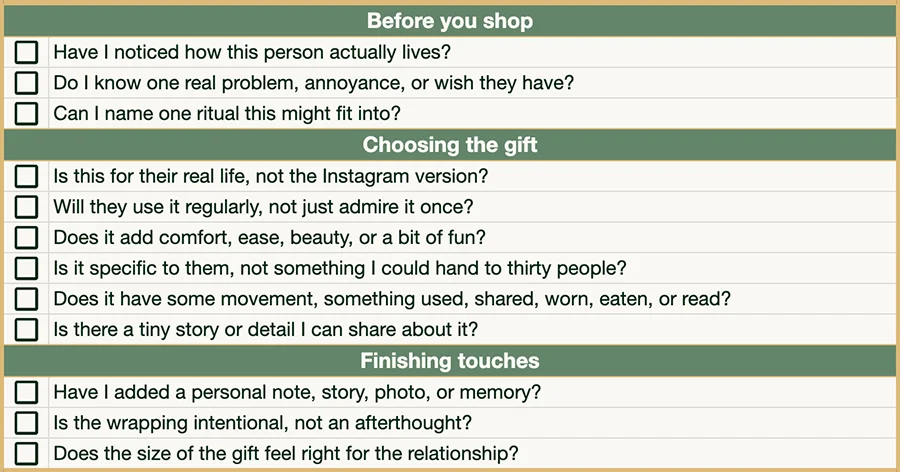
If you can honestly check most of those, you are done. Stop scrolling.
Make it a year-round practice
The easiest way to feel calmer next season is to start now:
- Keep a running note on your phone with people’s sizes, favorites, complaints, and wishes.
- Maintain a simple drawer with paper, ribbon or twine, blank cards, and a few “building block” items such as good chocolate, nice tea, and great notebooks.
- Once a year, look back. Which gifts were used, loved, or mentioned again? Which ones quietly disappeared? Adjust accordingly.
As one psychologist put it, gifts are often tools for connection and relationship-building, not just objects.
Over time, gifting stops being a December problem and becomes a quiet part of how you pay attention to the people you care about.

You might also like


.webp)







No items found.
